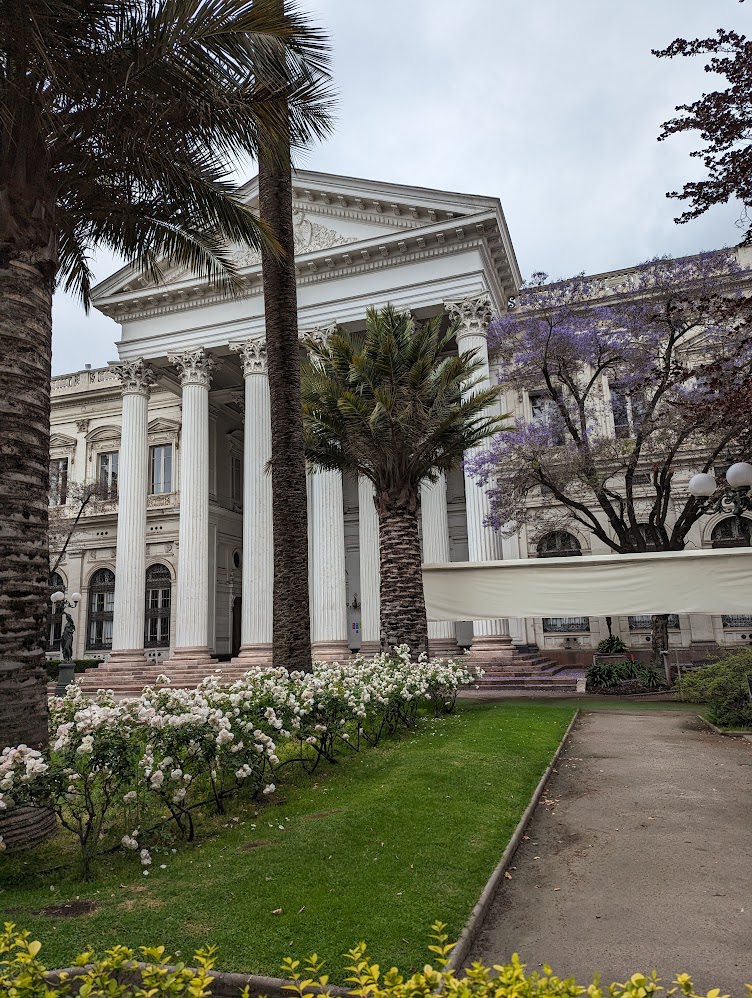
The Capitol
Good morning, Santiago! Or should I use the cleaning lady’s words: “Good morning, girls! You slept with your room door open!”
Those two muppets who came back to the hotel before it got dark, scared for their lives, didn’t even bother to close the door—let alone lock it. Nope, it was just left bloody open.
Well, welcome to New Zealand world!
Apparently, no one in New Zealand locks their doors. Why would they? As M put it, “I don’t even have house keys.” Anyway, nothing happened—or at least, that’s what we keep telling ourselves.
We only had one full day in Santiago, so we decided to book a tour. I hate traditional tourist office tours, so I usually hop on Airbnb and look for local guides.
Here’s why I prefer it this way:
- You meet someone local who isn’t sick and tired of showing people around.
- They’re usually more willing to chat since they’re not restricted by company or government policies. You can ask them about the current political or economic situation, and they don’t hold back.
- They’re more likely to show you less touristy parts of town.
- Food recommendations are more honest.
- If you’re lucky, you might make a new friend.
- The money goes to the local guide, not some company miles away—or worse, in another country.
The next day, we met our guide, Tiago, a local in his thirties. There were some Brazilians and Americans in the group, but they clearly didn’t leave much of an impression since I don’t remember anything about them.
As we strolled through the city, we couldn’t help but discuss some pressing issues. Tiago didn’t hold back when it came to the state of the country, U.S. involvement in Chilean politics, and more. We talked about the recent vote to change the constitution—a major political event in Chile—but it didn’t pass. He also explained that the minimum wage is around US $500, which, considering European-like prices in Chile, isn’t much. If you think your Chilean holiday is going to be cheap, think twice.
He also shared stories about the indigenous Mapuche people, their history, and colonization. Not sure how much you know about the Spanish and Portuguese “conquerors,” but they pretty much slaughtered every indigenous person they came across—except for the Mapuche, who are local to Santiago. The Spaniards lost multiple wars to them. That’s not to say they didn’t kill plenty of Mapuche people, but at least some survived, which was a rare occurrence.
If you think the Germans were bad during WWII, think again—this was far worse. And I’m saying this as a Pole whose family died in Auschwitz. The Spanish were just smarter about it—they didn’t keep records. Estimates suggest they wiped out 55 million people, about 90% of the population. Also, “genocide” as a term wasn’t even defined until after WWII.
Our guide said he was a mix of Spanish and Mapuche ancestry. Apparently, in Chile, about 40% of the population is mixed race, and only 10% are of “pure” descent.
I was surprised not to see anything or frankly to be shown—literally anything—related to the Mapuche people. Later, I found out there’s just one statue of them. ONE. I shouldn’t have been surprised, considering London has more statues of dogs than women, but still… There is also a pre-Colombian art museum and a Museum of Human Rights, which unfortunately we didn’t go to.
I have to admit, Santiago was a bit of a letdown. I expected more historical architecture. There’s some, but not much—thanks to the earthquakes that frequent the area. The city’s architecture is a mix of European influences—French, Italian, and Spanish being the most visible. But don’t expect Paris or Madrid—it’s just not on that level.
We started the tour at the Palacio de la Moneda, a colonial mint house that’s now the presidential palace and closed to the public. From there, we moved on to Santa Lucia Hill, the Metropolitan Cathedral, La Chascona (an artist’s house), the Gabriela Mistral Cultural Centre (which we unfortunately only used for the toilets), and the local market in the Bellavista area.
The Bellavista area bursts with vibrant street art—murals that spill over walls and alleys, giving the neighborhood a dynamic, creative energy. It’s worth wandering around if you’re in the area.
If you’re into shopping, you’ll find jewelry made with gorgeous lapis lazuli (a blue stone), some local chocolates, and a few other bits and pieces. Personally, I hate bringing home useless items, so I didn’t buy anything.
Overall, the most interesting part of the tour was talking politics and economics. 😄
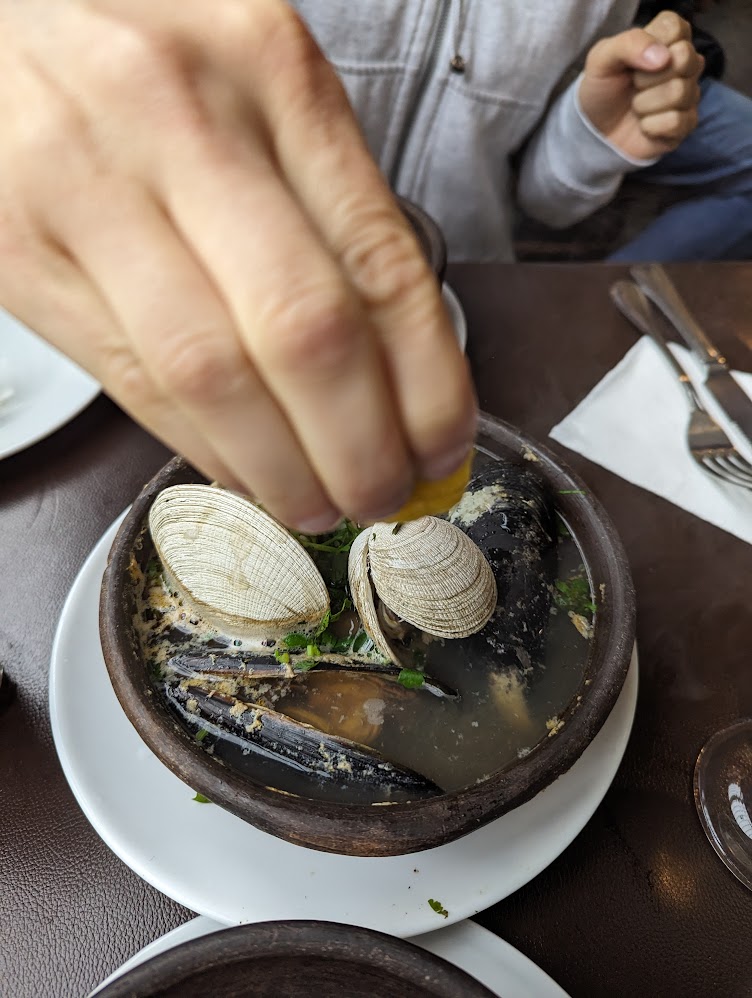
For lunch after the tour, our guide recommended Galindo, a very traditional-looking restaurant in Bellavista. We had a fish stew, which was really nice, and some horribly sweet juice. To this day, I have no idea what it was. We didn’t understand the explanation, and even though we tried to figure it out to avoid it in the future, we failed. All I know is that it was white.
After lunch, we decided to stretch our legs and prep for hiking by heading to the massive San Cristobal Hill park, which spans between our hotel and the city center.
There’s a cable car that offers great views, but for some reason, we didn’t use it. We walked instead. Parts of the walk were nice; parts—not so much. But you can spot some cool birds along the way, and if you climb to the highest point, you’ll get panoramic views of the entire city.
From up there, you can see the skyscrapers of the city center as well as the slum-like areas that are very visible on the drive from the airport. It’s a place where locals go for a run—or where middle-aged men in Lycra (MAMILs) go for a ride.
If you’re on your way to Patagonia, I’d say stop in Santiago to see how people live—it is the capital, after all. But honestly, it’s just a normal city—nothing special. Visit the three places we didn’t go to, as they do seem important looking back at it now: the Statue of the Mapuche People, the pre-Colombian art museum, and the Museum of Human Rights. Don’t spend more than a day or two here unless you’re planning trips out of town to the hot springs or the coast. And no, Santiago is not on the coast!

 Refried Neurons
Leave a comment