This time, we made sure to close our door properly before turning in for the night—only because I went back to check and discovered it was open again. Here’s a bit of advice: don’t use dollars in Chile. I did, to pay for the hotel, and couldn’t figure out why people say it’s better to use dollars in South America. The exchange rate was the same as on my Revolut app. But more on that later.
I’m a budget flyer and usually don’t pay to select seats, but this time I made an exception. It was a deliberate choice—flying along the Andes all morning meant the chance to see some incredible views. Of course, no one can guarantee the weather, but once mountains reach a certain height, you’re bound to see something. And oh, it was worth it! I spent three glorious hours admiring glaciers, lakes, and peaks from above. Every penny well spent.
We landed as scheduled and were picked up by the owner of the small car rental company we’d booked online. Deciding that Patagonia isn’t exactly “the end of the world” (well, sort of), we opted for a standard car instead of a 4×4. Everything went smoothly—we signed the contract, paid extra to cross the border into Argentina, and loaded our bags into the boot. The last bit was to put the contract in a safe place, as we’d need it at the border.
Now, did I mention that Patagonia is windy? Picture those movie scenes where someone’s vital paperwork gets snatched by a gust of wind, sending them scrambling around an industrial estate like headless chickens. That was me, two seconds after being handed the documents. Once it flew over the roof of a big warehouse, we were like, “Oh, shit!” He did say, “Hold it tight…”
The guy made a copy of his copy and said he couldn’t promise they’d accept it at the border. “Give me a call if they don’t,” he said. Great!
Hugry as hell, as we’d skipped breakfast, we decided to stop in Punta Arenas for some food before driving to Puerto Natales for the night. Here, I must admit something. Even though I constantly promise myself I’ll eat where the locals eat—even if it doesn’t look inviting, to get the real vibe and food—I’m as guilty as anyone of Googling where to eat. This time, it was M’s responsibility to find us a spot, and she did—Luan’s Restaurant.
We parked our red arrow (a Hyundai or Honda, one with the H) and were ready to head in. And here we go again with the differences between life in London and New Zealand:
Me: “M, can you put your stuff in the boot?”
M: “What for?”
Me: “I don’t know, maybe so no one smashes the window to take it?”
M: “Nah, you’re exaggerating. Are you seriously going to tell me someone’s broken into your car before?”
Me: “Yes. Two weeks ago, in fact. Is New Zealand really that safe?”
M: “Yep. I don’t even lock my car—no one does. I once accidentally got into my boss’s car and made a mess trying to start it, thinking it was mine!”
I insisted anyway. She reluctantly stuffed her things into the boot, while I, being the suspicious Londoner, checked the door handles.
Me: “Oh, and can you lock it too?”
M: “Yeah, sure—if it’ll make you happy…”
Breakfast was a bust. The first place was shut, the second wasn’t open until lunchtime, and we ended up wandering the city instead. This part of Patagonia is quite flat and not especially impressive. We saw a few listed buildings, the horrible Dreams Hotel on the waterfront (seriously, who approved that?), some street art, and locals doing aerobics on the boulevard.
By the time we finally got to Luan’s for lunch, we were ravenous. It was clearly aimed at tourists, but that wasn’t a problem. I stuffed myself with very cheesy dish name of which I can’t rememeber —you can’t go wrong with cheese—but promised myself to try something more local next time.
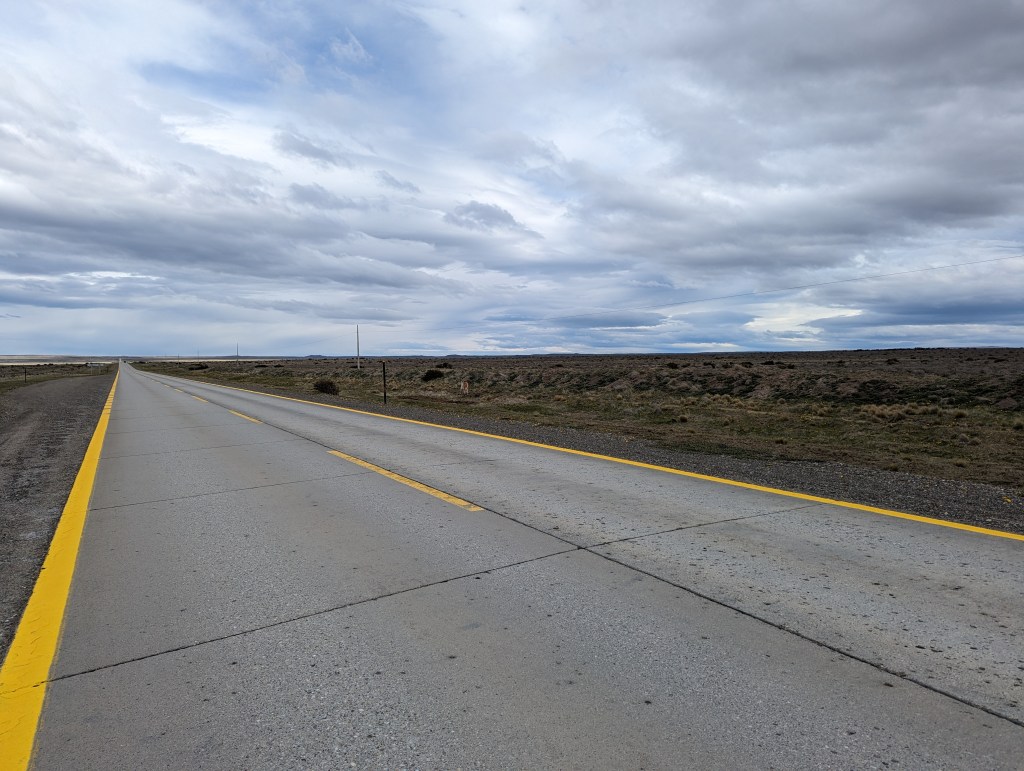
Patagonia is vast! For an Australian or Canadian, it might not seem extraordinary, but for a European, the distances are staggering. The 250km drive from Punta Arenas to Puerto Natales stretched through vast emptiness—just jaw-dropping scenery and the occasional farmhouse. The roads were astonishingly good, though, and almost empty.
Llama?! We saw a llama! We even saw a sign saying, “Be mindful of llamas.” Or, as a local later told us, not a llama but a guanaco. Still exciting! I’d wondered why they looked more like a mix between a camel and a llama—definitely less fluffy. I assumed it was the climate or that they’d just been shaved. Turns out, guanacos are part of the llama family but are not llamas themselves. They’re also very jumpy! You have to be mindful of them near the road; they might just leap under your wheels, like kangaroos in Australia. I love animals and would hate to harm one, but also, considering there was no phone reception along the 200km ahead, I really didn’t want to get stuck with a crushed car and a dead… guanaco on our bonnet.
A few miles before Puerto Natales, we were stopped by the police. I was driving, so I wound down the window, praying I hadn’t been speeding. To be honest, I wasn’t 100% sure of the speed limit. The officer said something in Spanish. Here comes my Spanish knowledge after living with Spanish flatmates for three years:
Me: “No hablo español,” I said, pulling off the biggest smile I could muster.
He smiled back and waved in a way I assumed meant: ‘antoher clueless tourist, just go!’ So I did.
We arrived in Puerto Natales late afternoon. Like Punta Arenas, it’s on the coast, but with much better views across the fjord. This is the base for hikers going to Torres del Paine, so there were plenty of shops, restaurants, and tour operators. Despite being much smaller than Punta Arenas, it offered more points of interest for tourists.
Our hostel wasn’t fancy, but it was warm and clean—exactly what we needed. We went out to find food and explore the town. It wasn’t as windy as Punta Arenas, but it was gloomy and cold. We had a short walk along the coast, took photos with the sculptures, admired some birds, and headed back between the buildings.
The architecture wasn’t particularly exciting—colourful, low-rise buildings that felt like a mix of remote towns in the US and Norway. But you don’t come to Patagonia for the architecture.
One shop window stood out—a big, inviting display with warm light. It was an art gallery. Imagine our surprise when we saw a Polish surname on the window! Intrigued, we went in.
We were greeted by a Spanish man who was married to the artist, Ewa Okolowicz. She was around, so we got to meet her! Ewa is a slow-fashion designer, painter, and illustrator. She grew up in Poland, met her Chilean husband during a student exchange in Spain, and moved with her family from sunny Valencia to Patagonia in 2017. Not your usual move, is it?
Both Ewa and her husband were lovely and welcoming. We chatted for a while. I haven’t mentioned this yet, but I usually travel with a toy sheep I crocheted during Covid, made of merino wool. Ewa was very impressed (or politely pretended to be) and, when I bought a yellow merino headband, she offered me extra wool to crochet a matching one for my sheep. So kind! Needless to say, Sheepy was over the moon.
By now, we were starving. For dinner, we chose Restaurante Los Coigues “Jechef,” which had brilliant reviews. We were lucky to get the last available table. The staff weren’t the fastest—or maybe it was just us being impatient Westerners—but the food was worth the wait.
Patagonia isn’t a great place for vegetarians, which shouldn’t be surprising given the climate. Vegans might find it even tougher. But for meat eaters? It’s paradise. I don’t remember exactly what I ate, but I do remember the house wine. Oh my God—one of the best wines I’ve ever had! Stupid me didn’t ask for the name, so now I have to go back just to find out.
M, still battling jet lag, was practically asleep in her plate. So, despite the wine, we didn’t stay long. Full and happy, we headed back to Hostel America.
Oh, the joys of life. For me, one of the greatest pleasures is walking into a warm room after being out in the cold. Our room wasn’t anything special, but it was super cosy. We went to bed quickly, leaving the window slightly open for fresh air.
That night, I had a nightmare—or at least I hope it was—about someone trying to climb through the window. I screamed, scaring the life out of M and probably waking half the hostel. After calming down, I remembered why the dream felt so real.
Years ago, in Tenerife, I woke in the middle of the night to find a man on the balcony of our third-floor flat, trying to break in. He bolted when I saw him, but I spent the night wide awake, armed with a kitchen knife and a chair wedged against the door. The hotel staff’s reaction? A shrug and “it happens sometimes.”
So maybe it wasn’t just a dream this time. Either way, the chill of Patagonia’s wind has nothing on the memory of an actual burglar at your balcony.
Good night!
 Refried Neurons
Leave a comment