There are benefits to not having a fixed plan. I know it’s not for everyone, but if you don’t mind occasionally sleeping in not-so-nice places, it gives you the flexibility to adjust your plans based on how you feel or, more importantly in Patagonia, the weather.
Of course, there are downsides—like scrolling through Booking.com during dinner or breakfast instead of just enjoying the moment—but since we had a 5-hour drive ahead of us, with only music or chatting as entertainment, we didn’t mind spending some dinner time figuring out what to do next.
The weather forecast for Torres del Paine the coming week was rain, rain, and more rain. Meanwhile, in Argentina’s El Chaltén and El Calafate, the skies were clear, and the sun was shining. The decision was obvious: head to Argentina. We’d have to return to Torres del Paine eventually since the car had to be dropped off in Chile. No rental company here allows you to return a car in a different city, let alone a different country. It’s such a shame because driving across all of Patagonia would be incredible. Sure, you can do it, but you have to drive back—or buy the car, though I’m not even sure if that’s possible.
After grabbing a quick breakfast at the hostel, we jumped into our red arrow and headed straight for the Cerro Castillo border crossing. Yes, there’s a crossing there. You really have to zoom in on Google Maps to see the road. We didn’t, but Google assured us it existed. There was a closer crossing near Puerto Natales, but since Chile’s roads were excellent, we decided to stay on them as long as possible.
For 60 kilometers, there was absolutely nothing—just grazing land and sheep, scattered with a few hills. It reminded me a bit of Scotland. When we got to Cerro Castillo, we were surprised to find that it consisted of a left turn to Torres del Paine, a small souvenir shop/café, a couple of sheds, and a right turn to Argentina. M popped into the café for a quick bathroom break, and we headed toward the border, about 5 kilometers away.
We passed an open barrier next to the shop. We wondered what it was for, and M guessed it might be closed when there’s too much snow. Five kilometers later, the tarmac abruptly ended, and I realized with horror that we were in Argentina. But where the hell was the border crossing?
M confidently said there was probably a joint checkpoint further down the dirt road. I wasn’t so sure—it didn’t feel right. Then it hit me: the bloody open barrier. That must have been the border! But why was there no army, no officials, no proper buildings? Why was it 5 kilometers before the actual border? Full of questions and slightly terrified that we’d illegally entered Argentina, I told M to turn the car around and head back.
Guess what? Cerro Castillo is the Chilean border crossing. Those sheds? That’s it. When we got back, the barrier was shut, so we had to park on the wrong side and go in for passport control. With big smiles, we approached the official. When asked where we were heading, we answered honestly: Argentina. We hoped they wouldn’t notice our car was parked facing the wrong way. Spoiler: they did.
The official, very politely, asked why we were heading to Argentina when we’d just come from there. Good question, isn’t it? Once again, I was thankful we were two blonde girls (though I’m not sure South Americans get the “stupid blonde” jokes). He informed us, with a hint of amusement, that we were illegally in Chile.
To make things worse, when you enter Chile, they give you a paper to keep and return when you leave. M nearly binned hers in Santiago, but I told her to keep it—only to stuff myown into my receipts-and-rubbish pocket. So, when the official asked for it, I panicked, rummaging through my bag to find the crumpled, dog-chewed-looking paper. I handed it over with shaking hands just as M’s passport photos fell out.
Apparently, she carries them in case of a last-minute visa need. Flashing her best cheerful smile, M offered the official one of her photos. I’m not sure how the conversation turned, but it ended with him laughing, saying he couldn’t keep it because he had a wife and kids. We got our stamps, a new piece of paper to keep safe, and instructions to drive safely and stop on the Argentinian side.
Five kilometers later, tarmac ended again, and we were on Argentina’s infamous dirt tracks—those washboard-like roads that rattle the car to its core. After another 3 kilometers, we came to what looked like a farm but was actually the border crossing. This time, we approached cautiously. If the barrier had been open, I’m sure we would have crossed without stopping again.
With passports stamped and paperwork sorted, we set our sat nav to take us to El Calafate via Esperanza. This longer route was recommended by the car owner because Google’s “fastest” route isn’t suitable for regular cars.
Every car and bus overtook us. With no spare tire, just a repair kit, and no phone reception, we crawled at 30 km/h for 7 kilometers on pothole-filled dirt roads. Those 7 kilometers felt like bloody 50.
Once we hit proper tarmac, the drive to El Calafate was smooth and fast. The Patagonian steppe stretched flat around us, with only low shrubs for miles, until the landscape suddenly changed. A few miles before El Calafate, the steppe dropped, revealing Lago Argentino and distant mountain ranges. The emptiness of Patagonia is breathtaking.
We stopped at a viewpoint—not for the view, but for a bathroom break behind some boulders. Love being a lady! Just as M pulled up her pants, a group of bikers arrived. Fantastic timing.
Arriving in El Calafate, we were stopped by police at the city entrance. Their border crossing may look like a farm, but their police checkpoint was more like an actual border. The officer took my British driving license, and his smile instantly vanished when he saw “London.” M, who didn’t believe me when I said the British aren’t particularly loved here, quickly waved my Polish passport. Smile restored: “Ahh, Polonia! Go, go.”
Relieved, we pulled into a petrol station, filled the tank, and set off. But our next stop wasn’t actually El Calafate itself—it was a national park 50 kilometers past it: Parque Nacional Los Glaciares. Nothing in the landscape leading up to the park prepares you for what lies ahead. Yes, it’s still stunning—steppe as far as the eye can see, with mountain ranges in the distance growing closer and closer. But these aren’t the towering peaks you might imagine.
We paid our entry fee, passed through the gates, and started driving along a pristine lake. The temperature began to drop—quickly. Around three kilometers before the car park, the snow-covered mountains came into full view, and then, in the distance, a glimpse of something extraordinary: a glacier, massive and glowing, a pale blue against the landscape.
There’s no proper hiking trail here, which is honestly a shame because the drive alone through the park was jaw-dropping. Walking it would’ve been even better. We entered the park late—maybe around 3 p.m., with the last entry being close to 4:30 p.m.—so it wasn’t crowded at all. We parked, layered up in our warmest gear, and headed out for a walk.
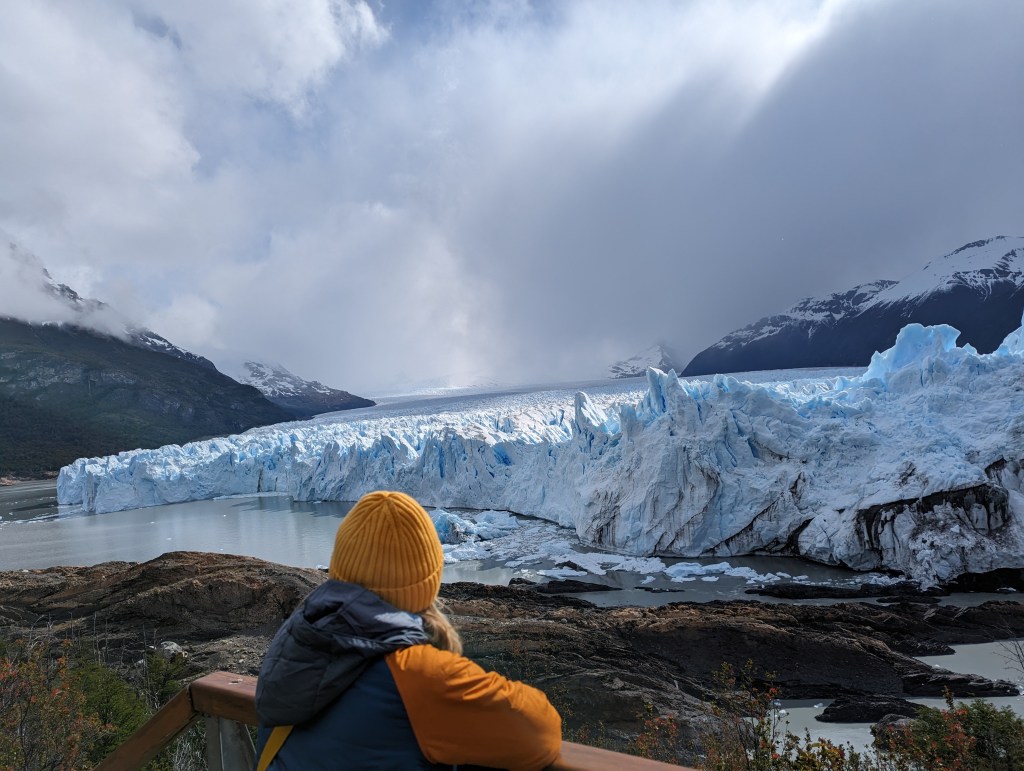
I hadn’t read much about the park beforehand—lazy traveler that I am—so imagine my utter shock when we passed the treeline, and in front of me rose this massive glacier wall, towering and majestic, its hues of blue shifting with the light. I couldn’t take my eyes off it.
There are walkways everywhere, allowing you to view the glacier from multiple angles, whether horizontally along its edge or vertically up the side. I was mesmerized. We found ourselves rooted in one spot, staring and waiting for the magical moment when a piece of the glacier would break off, crash into the fjord below, and send ripples of waves across the water.
I’ve traveled quite a bit, but this was one of the most breathtaking natural wonders I’ve ever seen. And the best part? You don’t need to be particularly fit to experience it. This isn’t a strenuous hike—it’s more of a gentle stroll along wooden walkways. The park is accessible even for wheelchairs.
There’s also an option to see the glacier by boat, which I imagine would be stunning, but we didn’t feel it was necessary. Viewing it from the platforms gave us everything we needed. This was about standing still, letting the sheer beauty of the glacier sink in—the colors, the sounds, the incredible scale of it all.
We must’ve taken over 100 photos in this one spot alone. We stayed for about two hours, but as the sun dipped lower and the temperature continued to drop, we reluctantly headed back. Plus, the park was closing for the evening, which meant we couldn’t linger any longer even if we wanted to.
Back in El Calafate, we checked into the hostel we’d hastily booked during our pitstop in Esperanza. To this day, I have no idea how it managed an 8.6 rating on Booking.com. Sure, we’d booked it last minute, and it wasn’t overly expensive—but it wasn’t dirt cheap either. Yet, somehow, it was far from the quality the rating had promised.
M took one look at the bathroom and declared she was cleaner than the shower. She refused to use it. As for me? I considered it for a moment before deciding I’d rather wait. Both of us ended up sleeping in our clothes and jackets, even though the sheets were clean. The blankets, however, were absolutely revolting. I’ll give them one thing—it was warm. But that’s the only positive.
For five minutes, we entertained the idea of leaving, but we were exhausted after the day’s drive. Considering it was just one night, we resolved to endure it.
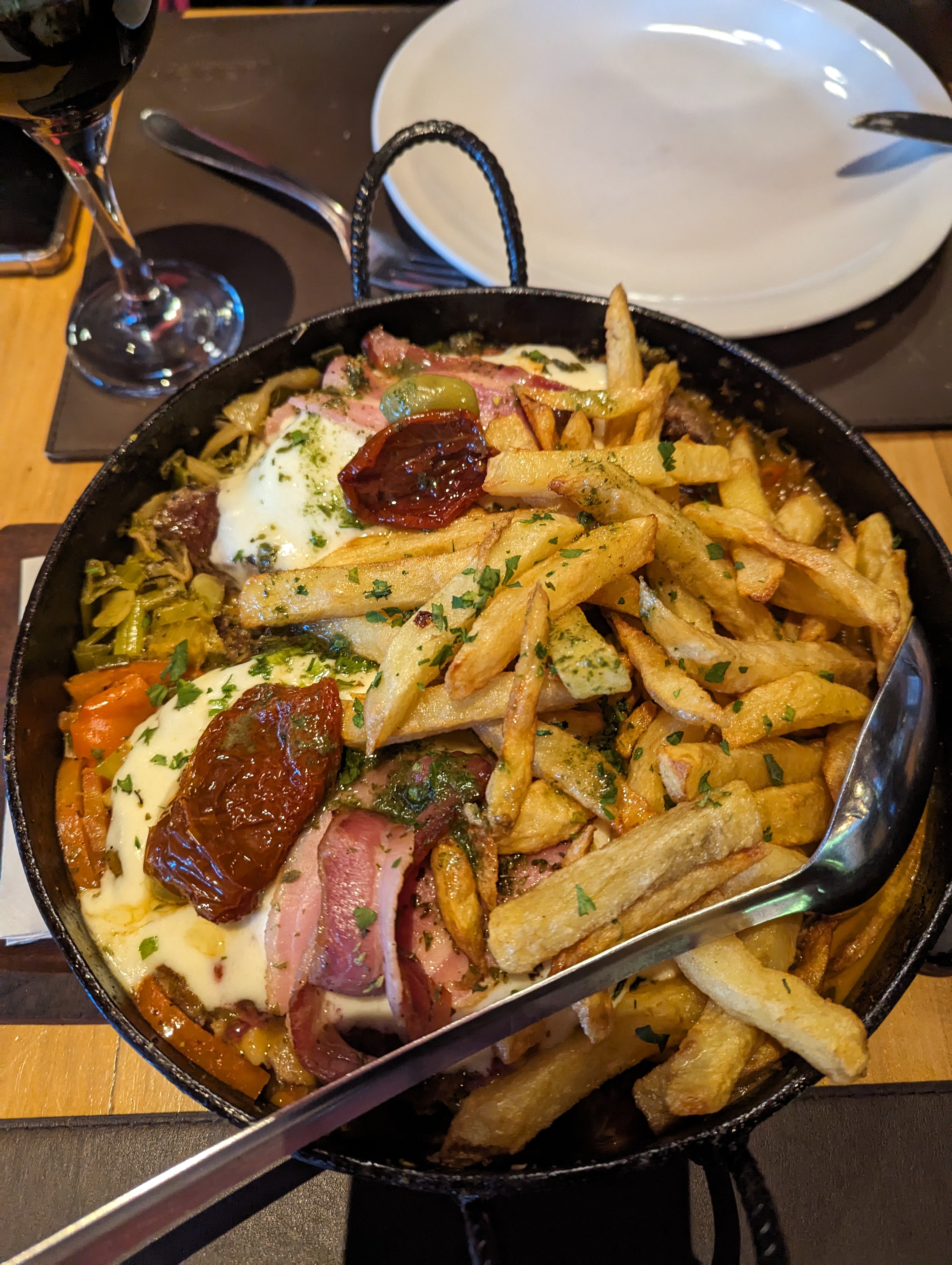
Despite our exhaustion, we weren’t going to skip dinner. We googled a restaurant, bundled up, and headed out. The place was packed—jammed with international tourists, tables squeezed close together, the buzz of conversation in multiple languages filling the air. At least the menu offered traditional food, which in this part of Argentina means one thing: meat. And then more meat.
We ordered one dish to share, thank god. There’s no way we could’ve eaten one each. Even splitting it, we struggled to finish. The portions were enormous, and while it was tasty, it wasn’t anything mind-blowing. Traditional food, after all, tends to be simple—comforting rather than complex.
Bellies full and utterly wiped out, we headed back to the hostel. It wasn’t exactly the restful night we’d hoped for, but at least tomorrow would bring a new adventure.

 Refried Neurons
Leave a comment