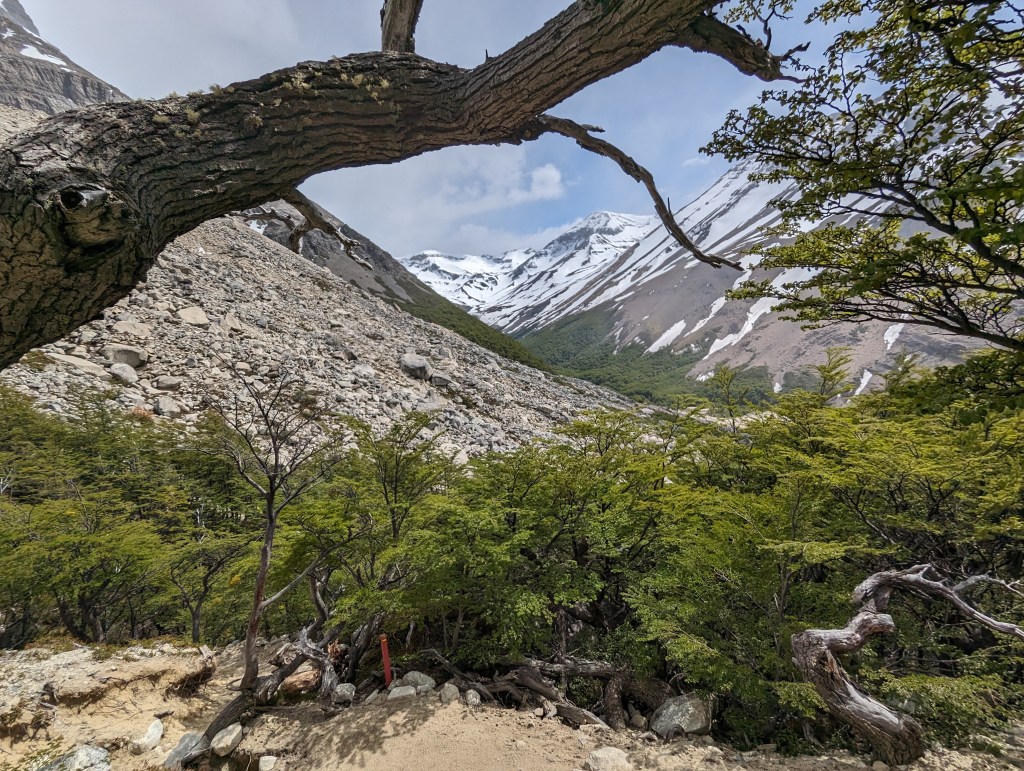
Not-so-very-good morning in Puerto Natales.
M is sick, so I’m heading out solo today. Packed my bags — and M’s bigger ones too — since we only had a two-night hostel booking, which meant we either had to extend the stay or sort something else.
I set off around 7 a.m. for the two-hour drive to Torres del Paine National Park for the main hike: Mirador Las Torres. On the way, I popped into a small shop near the border crossing to grab supplies. Breakfast at the hostel starts at 8, which is oddly strategic — all the park buses leave at 7 or 7:30, so anyone using them misses out. Savings, I guess. Still, the empanadas weren’t half bad.
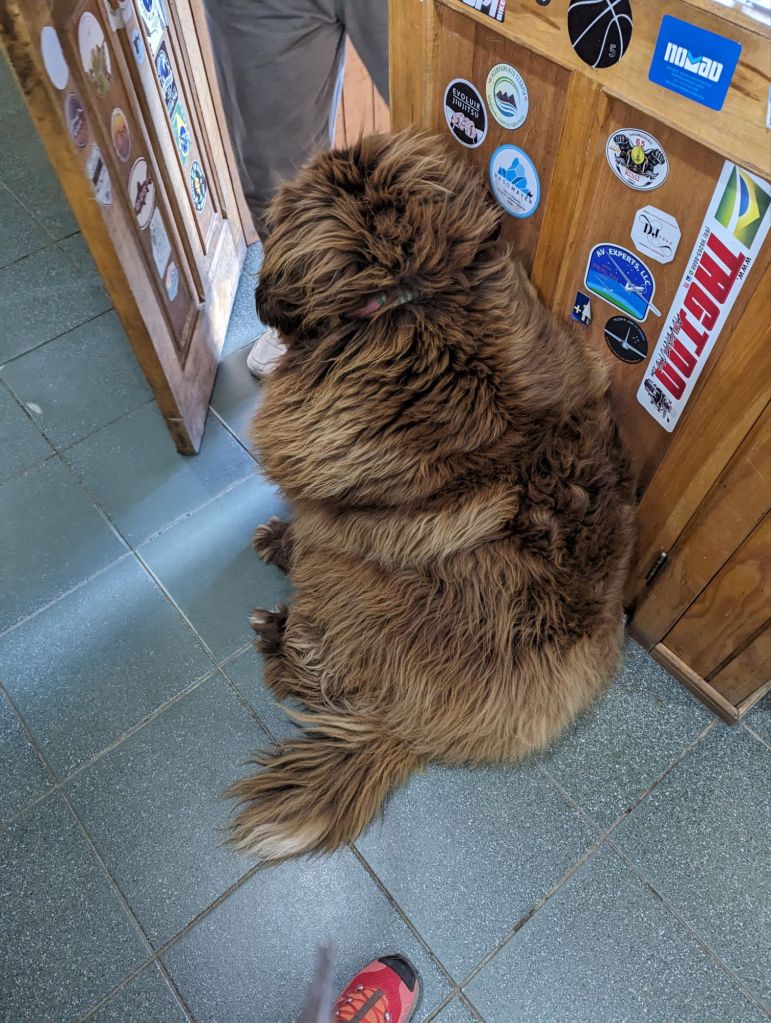
Quick shop, toilet break, a cuddle with a massive brown dog that looked like a bear, and I cracked on. I wanted to hit the trail before the buses, but I was already behind. And then came the bridge.
I have a master’s degree in engineering, specialising in bridge design and construction — and I was speechless. Yet another dirt-track, South American special: a single-lane, elevated wooden deck where your wheels must perfectly align with narrow tracks, or you’re swallowed by the void in between. And to spice things up — a steep incline with no visibility, because of course it’s two-way. Brilliant.

Going back wasn’t an option. Worst-case scenario: a minor crash or an unplanned dip in an icy river. So I did what any sensible person would do — closed my eyes (metaphorically), said a prayer, and floored it. I made it.
A few hundred metres on was the information centre. Boots on, water packed, snacks secured — I hit the trail. The big tour buses can’t make it this far, probably because of that nightmare bridge, so smaller ones shuttle people from the gates. Lucky for me, they hadn’t arrived yet. Off I went, alone… well, not completely. I had my sheep with me.
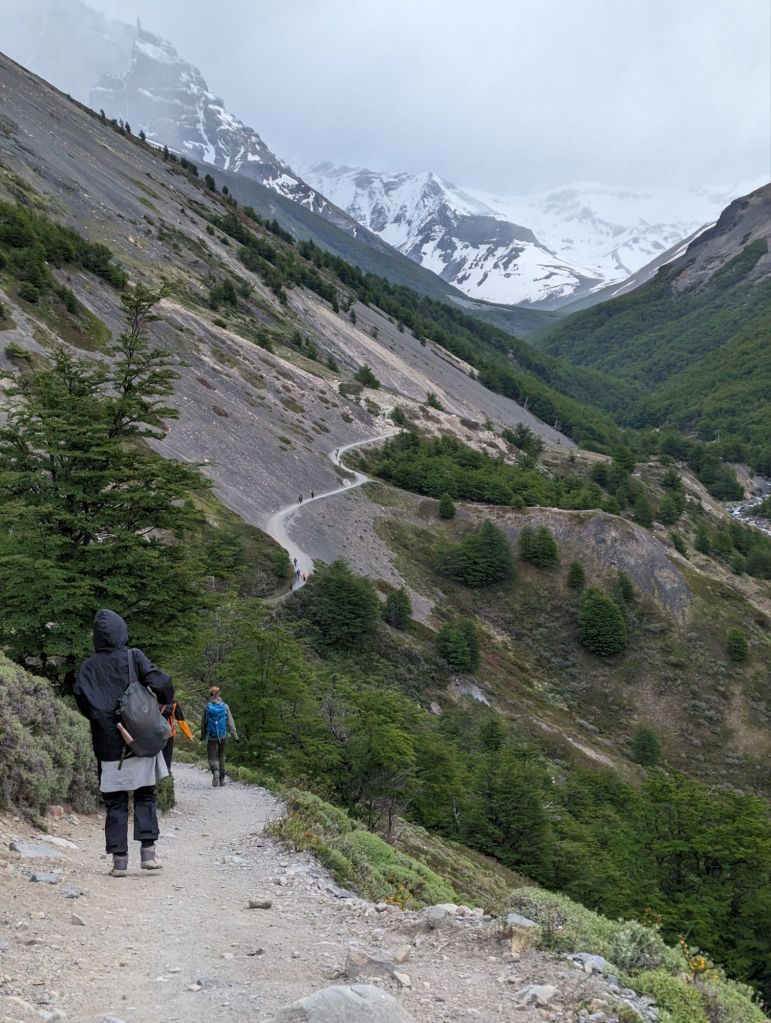
The trail was a straight shot up and down — 20 km round trip with 1,000m of elevation gain. AllTrails estimated 8 hours. I started just before 10. The first few kilometres were pleasantly flat, even had one of those cute suspension bridges that allow max two people at a time.

I passed a group of hikers — some fit, some gasping like they’d never walked uphill in their lives. And it reminded me why I don’t do group hikes. These tours usually rate “fitness levels,” but who decides what that means? If I compare myself to people running up the mountain, I’m unfit. If I compare myself to my work colleagues back home — who would’ve died at kilometre six — I’m a goddamn athlete.
Anyway, I overtook them quickly. Then another group, same vibe — some already collapsed on rocks, others clearly fed up having to wait. When the climb kicked in, it really kicked in — the trail narrowed into tunnel-like cuts eroded by water and foot traffic. And Patagonia did its thing: dramatic views, birds singing, and wind that could skin your face off.
Around 6km in, I reached the campsite with a small cafeteria — the first night stop for W trail hikers. It’s where you stay the night if you want to start your hike at dawn and avoid the day-trippers. I topped up my bottle, and just as I was about to set off, I bumped into the Dutch couple we met the day before. They’d stayed in one of the pre-set tents and had started the hike at 5 a.m.

They were already on their way down, and looked surprised to see me just starting. Apparently, they’d seen nothing — everything was shrouded in cloud. They couldn’t believe I was heading up so late. But here’s the thing: in Argentina, we’d discovered that Google Weather was freakishly accurate for mountain conditions, especially predicting when the peaks would clear. And it said: 12 p.m. was our window. I had two hours.
I shared my theory. Judging by their faces, they weren’t convinced. Oh well. On I went.
The next bit was a relatively flat section, winding through a forest along the river valley. In some areas, it looked like a sudden flood had ripped through — trees flattened or uprooted like some angry river god had passed through.
Just as I was thinking “I’m nearly there,” the real climb began. Boulders. Then more boulders. At first, the path zigzagged clearly between them. Then it disappeared completely and all I had was a field of rocks and the occasional peg sticking out of the ground to lead the way through this invisible maze.
Funny how much more chatty people become when you’re walking solo. Either I looked half-dead or people are just kinder to solo hikers. A lot of encouragement came my way — “not far now,” “you’ve done the hardest part.” I’ll pretend it was the kindness.
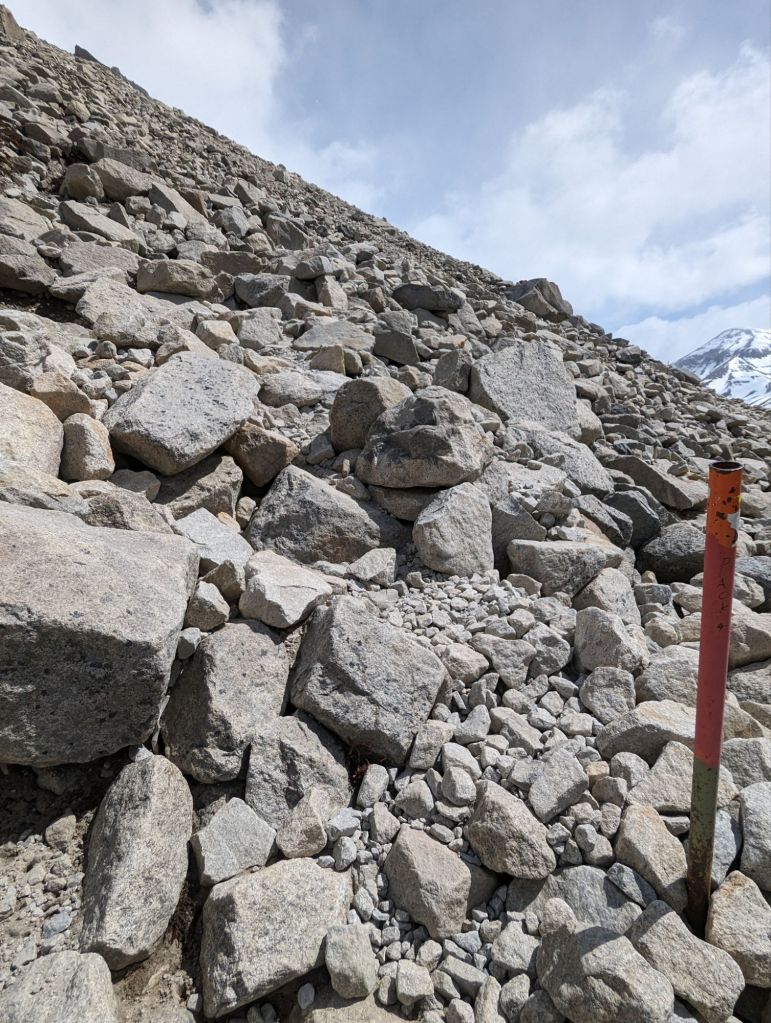
As always, you round a corner thinking this must be it, and nope — more rocks, more corners. But finally, behind a massive boulder precariously suspended in mid-air (not exactly comforting to walk under), there it was: the lake.
The holy grail.
I made it — 12:20! Just as predicted. And it was mind-blowing. Cloudy, yes, but I could actually see the peaks. The morning hikers had missed the view entirely. I got it — and some blue sky too.
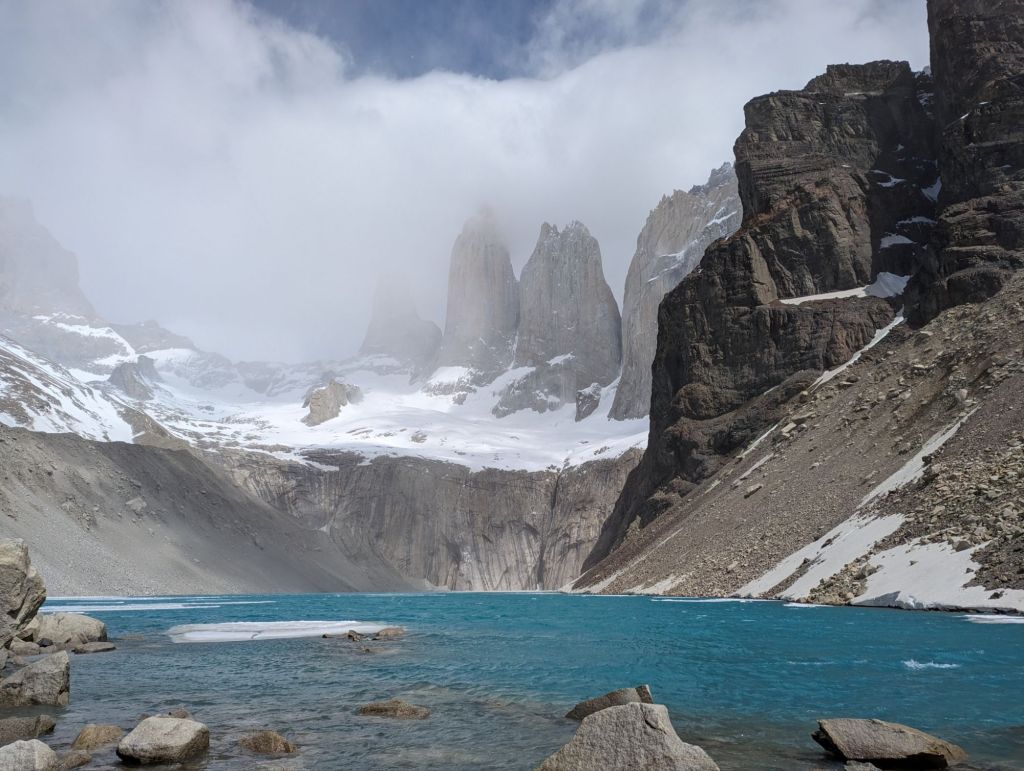
It was peaceful. The icy lake below, the Torres towering above, floating bits of ice bumping into each other like slow-motion bumper cars. I stayed for an hour, not out of exhaustion, just because it felt so good to be there. I had the place almost to myself — maybe 15 people — and it was perfect. Until it wasn’t. More hikers arrived, and by the time I left there were 50, and more coming.
Can’t really complain — it’s the most popular hike in Patagonia. What did I expect?
The way down felt like Fitz Roy all over again — people everywhere, turning the trail into a slalom course. I started running down, not intentionally, but because it felt better on my knees. That was, until I slipped and landed straight on my arse. Picked myself up, brushed off the ego, and carried on.
I took more photos on the descent — going the same way twice isn’t boring when the views are this good. Plus, you notice different things going the other direction.
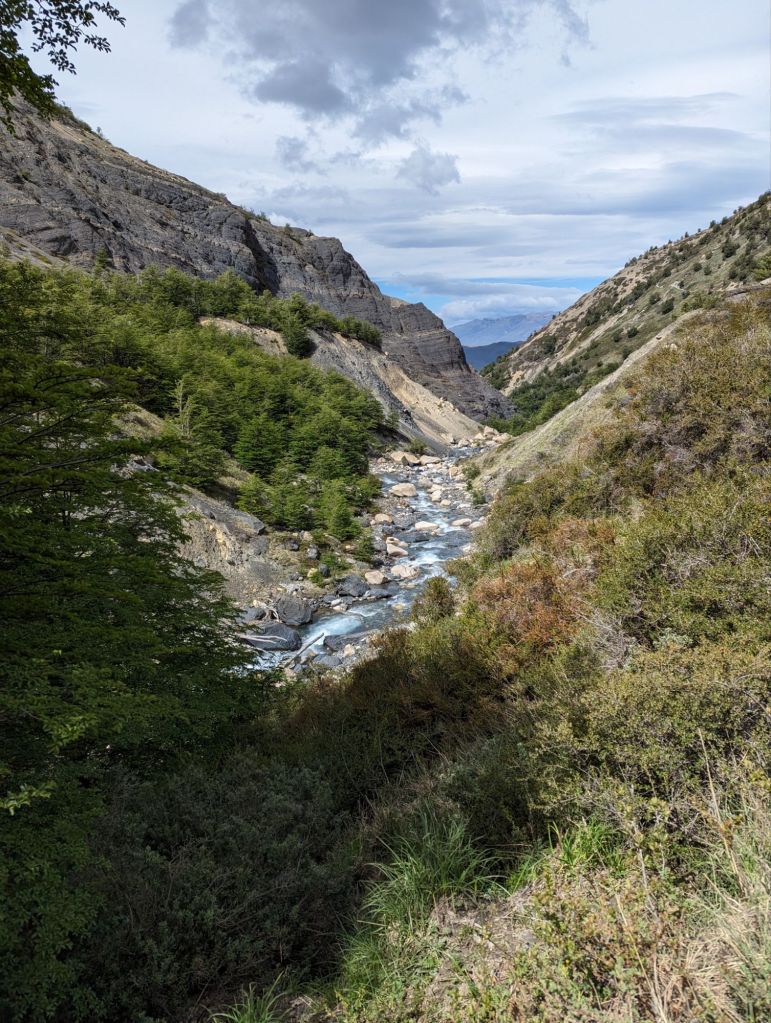
Two-thirds down, the Aussies reappeared — same ones who’d tried to chat up my sheep earlier. Ok, sheep may be the real reason why people were chatting to me or more likely to her. We walked together the rest of the way. One was fuming about some American who’d lectured him on trail safety after he jogged past. Seems like nobody — including Aussies — enjoys being told what to do by Americans.
We reached the info centre and had a snack while they tried to assess whether their rental car was still drivable — apparently, it had lost parts on the way when they hit one of the humongous pot holes. Still worked though. Patagonia cars are like Patagonia hikers: battered but moving.
At the park exit I saw loads of hitchhikers — people who’d finished their multi-day treks early. I picked up three: a Danish-Canadian couple and a British guy (I think). They looked normal. Didn’t seem like they’d kill me.
Turned out to be a great idea. The drive flew by with stories and laughter. When I told them Poland has wild bison, moose, wolves, and state-owned forests with no fences, they were stunned. Apparently, no one knows this. They all decided Poland was their next travel stop. And it made me realise — we seriously underappreciate our own nature.
Got back to Puerto Natales around 5 p.m., much to M’s surprise. I’d smashed the hike in 5.5 hours instead of 8. But there’s no reception out there, so she had no idea. When I finally got signal, I found out we were staying somewhere else — the hostel was full, and M had checked us into the best hotel in town. Fair play. I needed a proper bed.
While I was hiking, she’d gone to a pharmacy, flashed her inflamed throat at the staff and walked away with antibiotics. No doctor. No prescription. Not possible in Europe, but we were not in Europe. I’m glad she did though — she looked rough.
She also met a New Yorker while killing time in a café — a therapist travelling around Patagonia and working remotely. So, five hours after moaning to the Aussies about Americans, I was having dinner with one.
To be fair, she was lovely. But very American — confident, direct, slightly loud. I still can’t work out what it is that makes Europeans cringe a bit when it comes to Yankees.
After a good meal and a glass of wine, we called it a night. M had something planned for the next day — a cruise. Proper old-lady stuff. And honestly, after 20km of hiking, it didn’t sound too bad.

Next morning, we woke up in what felt like the official Patagonia hotel for every single Chinese tourist south of Santiago. Seriously — the breakfast buffet looked like a tour bus had reversed into it. But the food was good, and after a proper night’s sleep, even M looked vaguely human again.
Thankfully, there was no hotel pick-up (a rarity on these things). Just a five-minute walk to the meeting point. Easy. We boarded a coach — again, mostly Americans and Chinese — and were driven just out of town to board our mighty vessel: a catamaran big enough for 300 people. Lesson learned, never ever book anything that can take more than 20 people!
The itinerary was easy: sail through fjords, stop to hike to a glacier, have a very meaty lunch at a remote estancia, then float home. Simple stuff. But surprisingly lovely. Seeing Patagonia from the water was a whole new perspective — waterfalls tumbling down cliffs, glaciers peeking over distant ridges, birds nesting in every little crevice available, and seals lolloping about with smug expressions.
Outside was gorgeous but freezing, so I kept ping-ponging between the deck and the heated cabin. M didn’t even attempt the ping. She was still recovering and watched Patagonia through a thick layer of thermal glass while sipping tea.
We sat at a table with two American couples and a French pair — and you could tell instantly who was from where. The French woman was doing that impossibly French thing where she looked chic and athletic at the same time, like she’d stepped straight off a mountain photoshoot. The Americans, bless them, were very enthusiastic. The French barely spoke English, the Americans spoke no French, and yet we found it easier to chat with the French — probably because their idea of conversation didn’t involve bragging about everything American.
After two hours we disembarked somewhere magical: a glacial lake in a national park that’s only accessible by boat. Very exclusive. We had a short, easy walk with local guides to reach the glacier’s tongue. The water was that unnaturally vivid blue that looks edited in photos. Surrounded by dense greenery, it felt like we’d stumbled into a National Geographic spread.
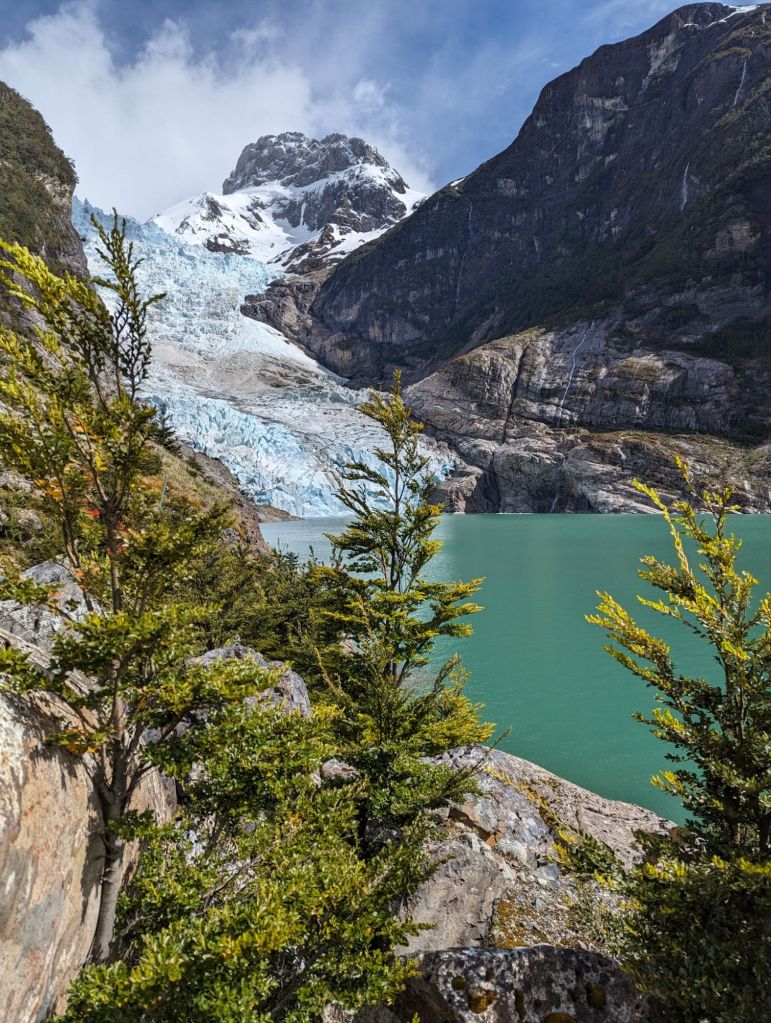
The guides showed us how far the glacier had receded in recent years. Short version: a lot. Enough to make even Trump sweat. Climate change is real, and here it was, melting right in front of us. Then they showed us these alien-looking orange mushrooms growing on the trees — turns out they’re edible. Raw. Locals put them in salads. Honestly, they looked like props from a sci-fi movie. We tried some. They were… not bad.
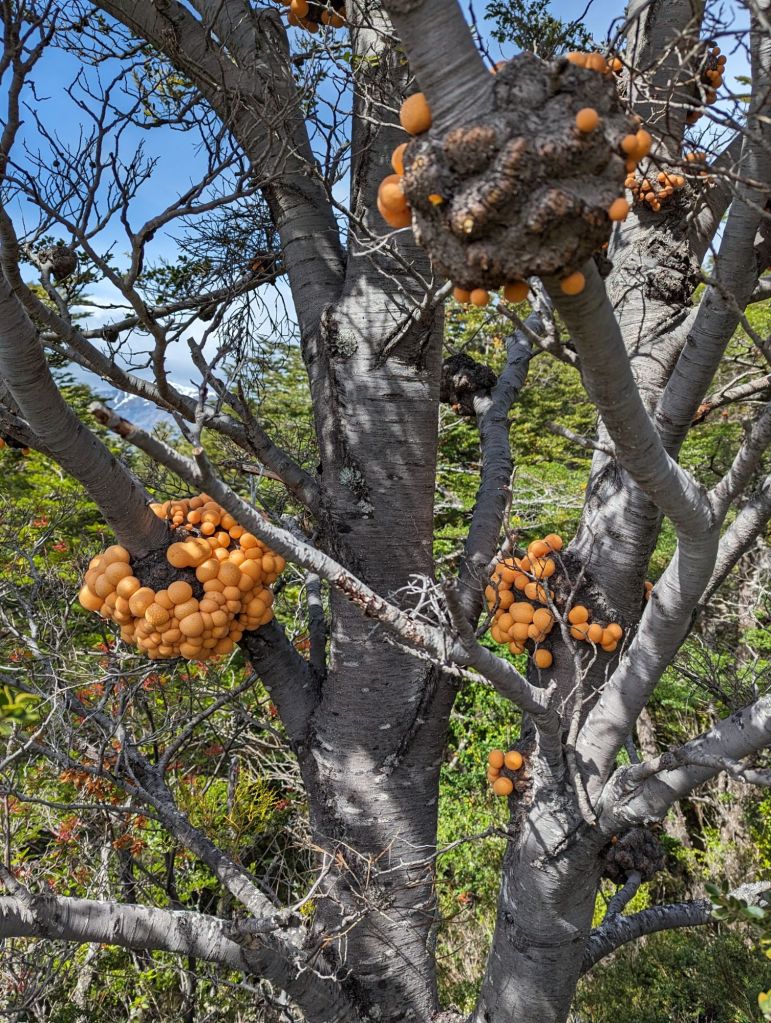
Also edible? The purple berries we’d seen in Torres del Paine. Apparently delicious. So why doesn’t anyone sell this stuff? Every menu in Patagonia is just meat, meat, empanada, meat. You’ve got edible mushrooms and wild berries growing all over your national parks and you’re importing iceberg lettuce?
We spent the rest of the walk like foragers on a mission — picking berries and mushrooms and getting increasingly cocky about identifying the ripe ones. Most of our group was, let’s say, not built for hiking, so even with all our snacking and dawdling, we were still back at the boat 20 minutes before departure. We sat on the rocky beach, sun on our faces, air crisp and clear, thinking, “Alright Patagonia, this’ll do nicely.” I even risked a T-shirt. Instant regret. Within minutes, I was being eaten alive by tiny demonic flies.

Back on board, we sailed to the estancia for lunch. The meat-fest. Tables groaning with lamb and beef and more lamb. By this point, even I was starting to dream about vegetables. The place looked like it could host a wedding with the Andes as a backdrop. Stunning.
By late afternoon we were back in Puerto Natales. We’d already checked out of the hotel, since I was flying to Cuba the next day — a midnight flight from Punta Arenas, which meant we had a 3.5-hour drive ahead.
Bellies full, car loaded, playlist on — we rolled out, one last drive through the Patagonian emptiness. Just fields, mountains, clouds. Sheep doing their sheep things.
Good night Patagonia.
 Refried Neurons
Leave a comment