Normally P and I fly together. This time, however, the universe conspired to make us arrive separately: me fresh from Patagonia, he from London. Just a neat little four-hour difference in arrival time, which sounded manageable in theory but in practice meant we were both fending for ourselves.
My route involved two changes: Santiago and Lima. I barely remember Santiago, so I assume I must have glided through in a trance. Lima I remember only because it was not at all what my brain had stored under “Peru.” For some reason I always pictured lush rainforest and jungle parrots, but what you get when you land is essentially red farmland and beige desert. Think Marrakech with llamas. The airport was bursting with llama merchandise. Not live llamas, which would have been fun, but every conceivable product made from llamas.
The final leg of my flight was the kind of moment where you think life has given you a treat. At check-in, they offered me an “upgrade” to business class: reduced from $300 to $30. Naturally, I congratulated myself on this once-in-a-lifetime chance to fly stretched out with Champagne and a bed. What I actually got was… the middle seat blocked out with a tray on it and a slightly nicer toiletry pack. Still, not the worst $30 I’ve ever spent, but not quite the flat-bed fantasy either.

Arrival went smoothly—until passport control. I handed mine over, the official vanished with it, and I was left waiting. Ten minutes, twenty minutes. Eventually I decided the marble floor looked inviting, sat down, put my headphones on and practiced calming thoughts: I have a second passport. I can always fly back. After half an hour another official appeared and asked if I had residency somewhere else. No residency, but another nationality. Away went passport number two. Cue inner voice: Don’t panic, it’s a communist country. Dollars always work. Except… you spent them all in Argentina, clever you.
At last, the first official reappeared, apologised, and handed everything back. Off to customs, where the form essentially asked: Are you carrying multiple phones? Multiple cameras? Medicines? Which, yes, yes, and yes. I braced for interrogation as an amateur spy, but they waved me through without interest.
Now, here’s the first surprise: Havana airport does not have the usual arrivals hall with cafés, kiosks, and bored relatives waiting. You clear customs and boom—you’re on the street, instantly surrounded by cab drivers. I had hoped to pick up a SIM card, since my LATAM e-SIM worked everywhere in South America except Cuba. No such luck.
So I grabbed an official yellow cab. Alas, not the glorious retro American machine I’d pictured, but a wheezing modern Chinese car that rattled like a kettle and smelled faintly of fish glue. Still, it had air-conditioning, which is not nothing.
The 30-minute ride into town was like watching a rolling museum: streets lined with vintage Chevrolets, Buicks and Fords, all somehow still moving, against a backdrop of colonial buildings in every stage of glorious collapse. My driver then admitted he had no idea where, exactly, he was supposed to take me. When you book a cab at Havana airport, you pay at a desk, they scribble the address, and the driver just… wings it. He recognised the neighbourhood but not the street. My phone had no network. His phone had no map. Eventually, after a prolonged back-and-forth involving my host’s phone number, we made it.
The building was a handsome colonial townhouse. Our host was waiting on the balcony and, like Juliet in Havana, dropped the key down. The room was tidy and welcoming, if not my aesthetic. Imagine: colonial charm meets Poland in the 1990s, with a dash of gypsy caravan. Not much style, but plenty of heart—and crucially, our own bathroom.

After nearly 20 hours in planes, all I wanted was a hot shower. Back in Patagonia, I’d bought giant bottles of shampoo and conditioner but left them behind, convinced they wouldn’t be allowed in hand luggage. (South America doesn’t have the 100ml rule, as I realised too late at security.) In the bathroom, I found only a bar of soap. When I asked about shampoo, our host looked apologetic: there isn’t any. Not “there isn’t any in this bathroom,” but “there isn’t any in Havana.” Apparently the entire city was shampoo-free.
Bemused, I washed my hair with soap, reminding myself that I was born just before communism fell in Poland, and grew up on stories of empty shops. This was exactly that. Shampoo would turn up somewhere… surely.
Revived, I wandered down to the casa’s bar—yes, a full bar—and was rewarded with the best mojito of my life.
Practical tip: before you go anywhere, download Google Maps and Google Translate offline. Hardly anyone in South America speaks English, and my Spanish, after two weeks, was still kindergarten level. Translator saved me repeatedly, though it would benefit from a Cuban dialect mode—it rarely matched what locals actually said. Luckily, my host’s daughter set me up with a spare SIM, so hallelujah, I had network again.
Our host also offered currency exchange, the Cuban specialty—everyone does it, quietly, under the table. Not knowing the real rate, I swapped $100 just to have cash for the evening.
By then Piotr’s flight had landed. I’d sent him our location, hoping to spare him my ordeal, but with no network he had the same taxi pantomime. Hours later, frazzled but intact, he arrived. Also shampoo-less.
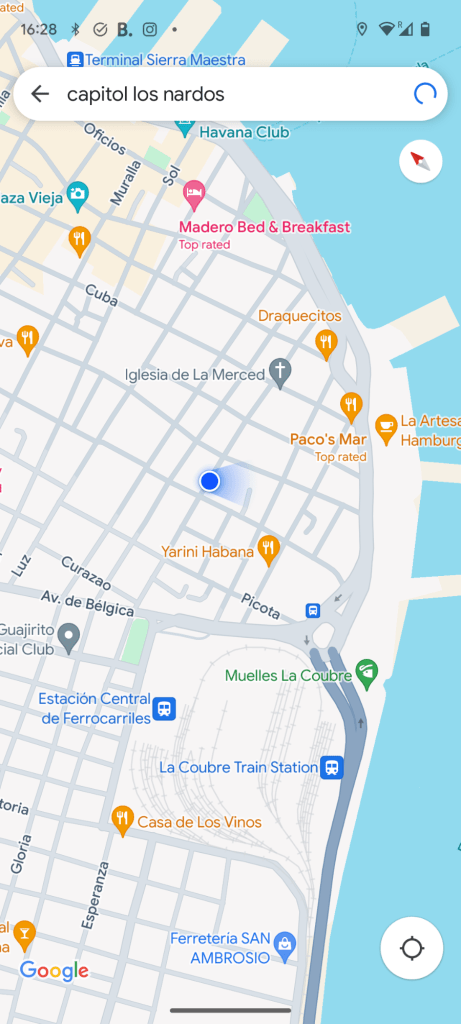
It was late, but hunger always wins. Our neighbourhood looked rough by day and positively dodgy by night: half-collapsed townhouses, rubbish spilling from bins, skinny cats in clowder formation. Street lighting was sparse enough to encourage both romance and robbery. But a short walk led us to the Capitol building. It is a near-twin of the one in Washington, immaculately maintained, planted, guarded, and utterly unlike the chaos we had just walked through. Guards ensured you didn’t so much as breathe on the pristine pavement.
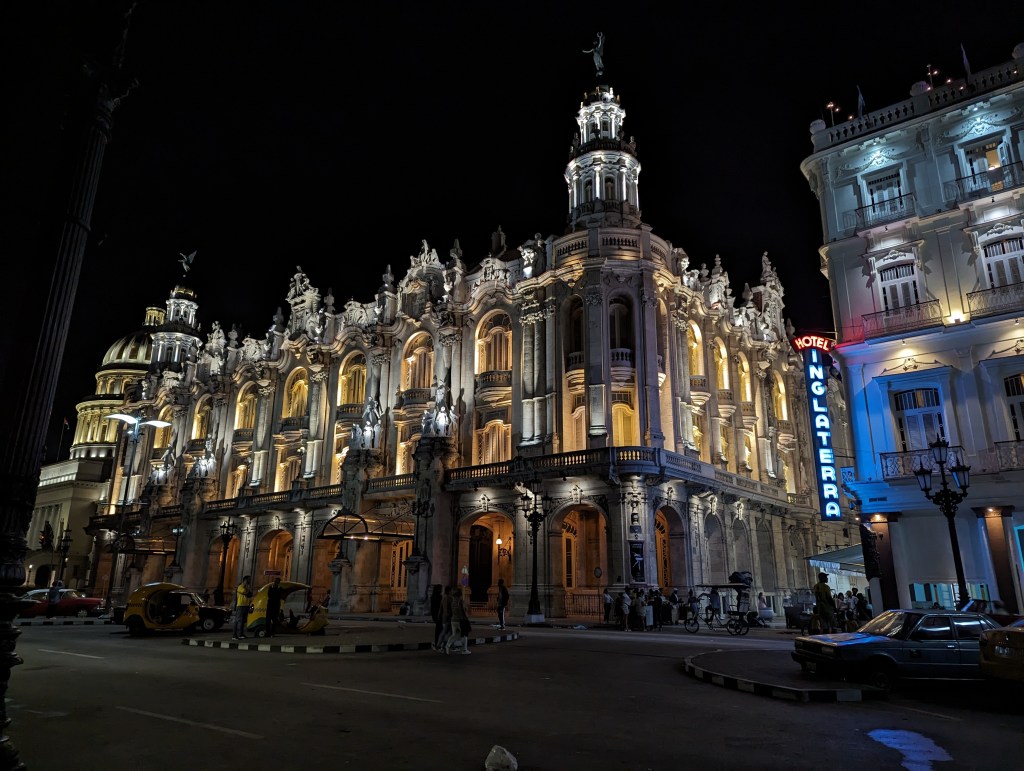
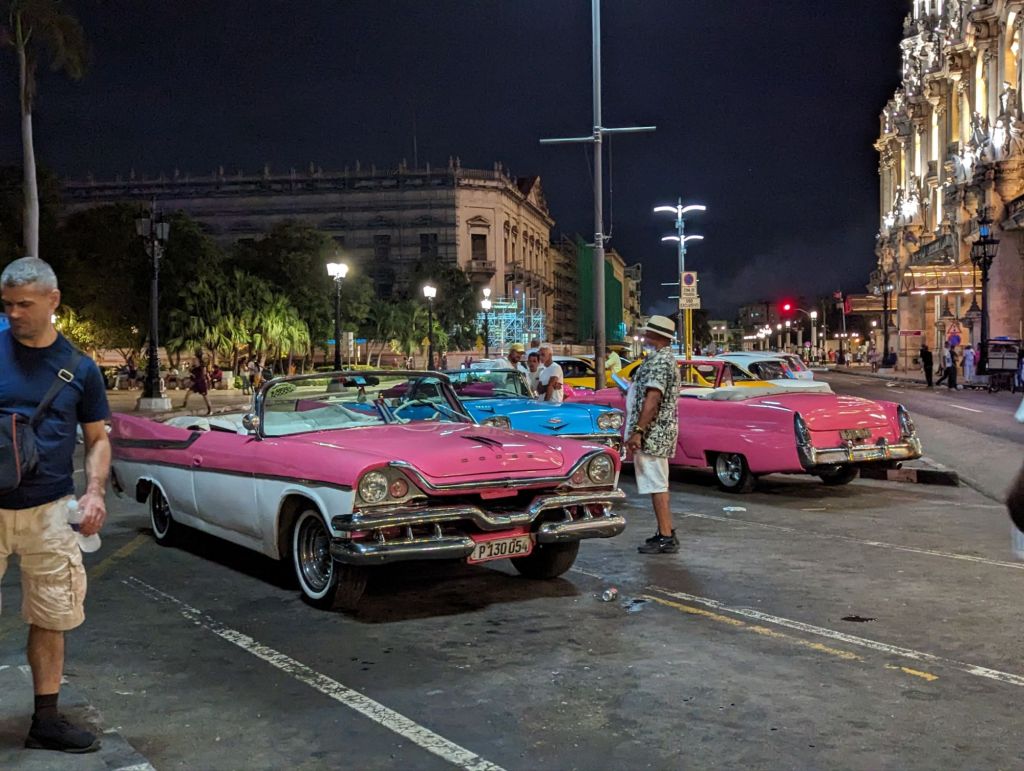
We wandered past Hotel Inglaterra, the Grand Theatre, and a line of vintage pink and purple convertibles, their drivers eager to part us from our dollars. Ignoring them, we ducked into a side street bustling with locals. Restaurants were scarce, but women sold street food and tiny take-out chicken shops did brisk trade.
We bought roast chicken, a Cuban “chocolate” bar made of peanut butter, a couple of soft drinks, and ate happily on a bench. We could have gone to a hotel restaurant like the tourists, but hotels are state-owned—meaning the money flows straight into official pockets, not the public. And anyway, chicken in the street tasted better.
Bellies content, we walked back through the ruins and cats to our casa, ready for sleep. Day one in Havana: survived.
 Refried Neurons
Leave a comment